Showing posts with label My Art. Show all posts

Thursday, December 18, 2008

One Crane Wing Down But Much to Do


This is an updated photo with the cranes now attached.

I laid out one of the crane wings last night. There are over 200 cranes in place but when completed there are going to be approximately 300 cranes per wing, with the neck, head, tail and back taking on the 400 or so left over to make 1,000. The picture is from my phone so not much detail, but the wing is over five feet across which will mean approximately an eleven foot wingspan.

However, I am not sure about the support yet to hold it's shape. I have the ceiling tile wire on the underside, but that has to be moved to the top, as I would prefer not to see it from the bottom. But that means I will have difficulty attaching the cranes to the wire frame. This is intended to be hung from a high ceiling in the UWT library, so care in lifting and setting will be necessary.

Most importantly, it still does not have the rigidity I wanted, which means there will need to be more support wires to attach when it is hung. I will be gluing overlapping wings together which helps, but also means one mistake could cost me time in crane replacement.


You should be able to see the outline of the wing from the positioning of the black cranes.

If anyone has additional ideas let me know. Thanks to Pete and Judy for earlier help.

Saturday, November 8, 2008

Folding 1000 Cranes to Make 1


After November 21st, which is the South Sound Technology Conference, I am going to get to work finishing another project that has been in the works for awhile. Some time ago I began to fold a thousand cranes on my own, just to satisfy one of those things you set out to do before you die. The cranes piled up and I boxed them away, with an idea of what I hoped to do with them.

The idea is to hang them, in formation, in the creation of one very large crane This would would represent the 1,001st crane. However, one big question left was where I would hang it. My wife would not allow it to take up to much space in the living room, and why even have it in the ceiling space of the garage if no one could see it.

After conducting a few origami classes at the UWT library, an idea was formed in conjunction with the origami displays that we put together there. The crane could hang as a display from the rafters of the Graduate Library reading area. At least for a while. To read more about it, check out this article from the University of Washington, Tacoma's student newspaper The Ledger.

Two challenges remain. Both you can help me with.

The first is that although I folded over 1,000 cranes as part of my mission, over time I have given away hundreds back to children and used many others to create my "Escaping Cranes" displays. I need to replenish the flock.

Uwajimaya, a wonderful Asian supermarket and bookstore, was kind enough to donate 100 sheets of black origami paper for the project. Thank you to Anna Sayler for making the ask. I will use these to accentuate the outline.

The second one is critical and I need your advice. I don't want to attempt to hang them mobile style so that the move in circles or with any breeze. I have the oval frame and fabric to run the lines through if I wanted to use this technique, but I am hoping to create more rigidity.

I am thinking of a thin metal wire frame to run them along and hang in the center of to create bulk, but don't have the expertise to create it.

If you have worked with wire frames or welding thin pieces, I would love to hear from you.

Tuesday, March 25, 2008

Some Origami Notes on Paper Size


Whenever anyone picks up and starts to play around with Origami they usually don't give much thought to paper size. Traditional, craft store ready, multicolored, white sided paper is in abundance and approximately seven inch square size paper is supplied with most sets of Origami kits. For those starting out or teaching elementary students in classes of 20 to 30 this is just fine. Picking up a 100 sheet package is no big deal and not too expensive.

But there are several reasons to vary your paper size. Using several Montroll models from his Origami for the Enthusiast book, I will endeavor to illustrate.

Reason Number One: Two create different looks for the same model. Especially when putting together a display. Sometimes the class of kids want to combine their efforts into a much bigger display. Say that you are creating fish and other sea life for a hallway display. By creating different sized models of the same fish you can create a school like effect complete with younger fish.

I habitually make the Tyrannosaur, often leaving it at the table I'm sitting at, and do so with whatever paper is available whether a gum wrapper or a tablet page sized to a square. Even though I like the model on it's own, when combined with several different sizes of paper you can develop a sense of family. I have included a small red paper clip to give you an example of scale on this one.

Reason Number Two: To conquer a model. There are some models that are more difficult to complete than others, and when you graduate to some of the more difficult pieces it can get frustrating. The solution: go buy yourself a bunch of large sheets of paper to work with. Sometimes when looking at some of the models in books or online I wonder how they possibly could have folded something like what I am seeing. Often they are done using much larger paper than is readily available to the occasional folder. Go to Uwajimaya or get some online. There are 9 inch square sized sheets available at Amazon, but I would go even bigger if you can find it.

Two models that frustrated me a bit before I worked through them were this Tarantula and what I call the creepy looking baby.

Though they started from much different sized paper, the larger Tarantula helped me understand the folding instructions enough to successfully complete the smaller sized one. The smaller one is actually less messy than the larger one for it as well.

The baby is a Robert Lang model, and comes complete with diaper. I never would have successfully folded this one without the larger paper size. Additionally, I like the resulting size of the model as it is almost "doll" sized when complete.

Reason Number Three: To challenge yourself. Once you have a model down, the challenge then becomes to see how far you can miniaturize it. The smallest Tyrannosaurs above are pretty small, but I like to see if I can even go smaller. I once made some cranes and some penguins as small as I could, then stiffened the paper with a clear lacquer spray and attached them to earring backs.

Reason Number Four: So people can find them. OK, so this reason may not apply to you, but recently I left a turtle for people to find at a local park. No one found it, at least that I am aware of. Now if I had just gone with the larger paper, I think it would have been difficult to overlook. I like the smaller version better, and when using plain paper it loses a little something. But sometimes you just have to go larger.

Reason Number Five: To size correctly to your display. I chose a specific type and size of a paper for the Montroll turtle model mentioned above, so that it would fit nicely into a shadowbox display I was working on. The one pictured was an early pass at something I did on a bigger scale (meaning number of turtles, not size of paper) for my son. I like the effect the checkered paper I used gives to the end result.

There are certainly more reasons, so please provide any others that might come to mind.

Friday, November 30, 2007

Tacoma Musical Playhouse Update

Back in July construction was being done at the Tacoma Musical Playhouse over on 6th Avenue . You may recall this exterior view.

Phase One of a reconstruction of the entire facility is now complete. Added adjacent to the old theater were a green room, bathrooms and dressing area for the actors (much better than having to change in the aisles backstage). For that the actors are grateful. Unfortunately I do not have any pictures.

However, at last nights dress preview of Meet Me in Saint Louis, Julie was able to snap a few photos of some of the other improvements.

The entry to the the theater has shifted to the left of the entrance where formerly a different facility existed and has added to the size of the lobby substantially.


As you enter, new floor tiling might catch your eye.


The concession stand is now on the other side of the longer lobby with far more room to serve patrons.


Now gone are the overhead tiling squares and dingy lighting. In there place a higher ceiling and beautiful lights with accents and recessed lighting surrounding room.


To do it justice you have to see it, but here are the artist conceptualizations that represent the larger view.


But in the end, the single greatest improvements to the theater going experience were to ...........

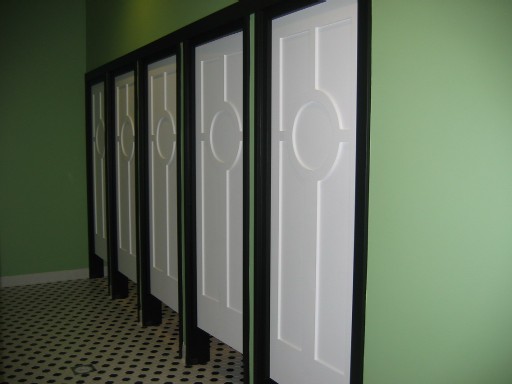
.... the bathrooms.

Anyone, especially if you are a woman who had to deal with a line during intermission created by the grand total of two stalls, can appreciate these changes.


And there is a SECOND line of them on the other side.


I suppose that it is fitting that the next show I will be in at the theater is Urinetown. More on that at another time.

These improvements benefit greatly the experience of the actors and patrons of the theater. In the next phase, an orchestra pit for the fine musicians who make live accompaniment a hallmark of the shows performed at this musical theater.

Thursday, August 16, 2007

MSL Camp at the Institute


For four weeks in August, selected students from around the South Sound participate in a four week summer camp with an important focus. The Math, Science & Leadership (MSL) program at the Institute of Technology is a multi-year program that begins with a summer camp for students who will be entering 7th - 11th grades here in the South Sound.

The goals of the program are to help students recognize and develop their potential to excel in math and science, ease the transition from middle school to high school and high school to college, encourage the pursuit of math and science electives at the high school level and to pursue postsecondary degrees in these fields.

Believe me, we need more scientists and engineers.


I spoke to a class of eighth graders in during the second week and enjoyed myself greatly. They were outgoing, respectful and interested in the discussion. My focus was on origami and its relation to mathematics. In particular I highlighted Robert Lang, a noted physicist and engineer, who has authored or co-authored over 80 technical publications and 40 patents on semiconductor lasers, optics, and integrated optoelectronics.


He has also presented several refereed technical papers on origami-math at mathematical and computer science professional meetings. His profile on CBS 60 minutes was shown during the discussion via the web in a smart classroom, and the feature noted the applications of origami to engineering problems ranging from air-bag design to expandable space telescopes.

And then of course we made cranes.

Friday, August 10, 2007

Escaping Cranes Two: Red Version

I had a number of positive responses to my display of escaping cranes. One person convinced me to make another with their selected color scheme so that it would look good in their home.

The colors are red, gray, white and black, and though I wasn’t thrilled with the way they filled the glass container, I really like how they look escaping up into the sky.

With the first one I used about 80 or so cranes but with this one, given the container was slightly smaller I ended up using closer to 60 or so.


Monday, August 6, 2007

Stephen King, On Writing

One of the nice things about getting away to the ocean or camping is that you have the chance to be out in the open air, so you can read. It is an obvious consequence of getting more exercise than the normal work week would allow, combined with the elimination of electronic distractions, but I always get more reading and writing in when I am vacationing. Last year, while in Sunriver, Oregon, I managed to write a chapter for Mitch Ratcliffe and Steve Mack's The Podcasting Bible. That is something I wouldn't have gotten done without removing the distractions of the everyday.

This long weekend I reread for the (place unremembered number here) time Stephen King's non-fiction book, On Writing. This book is a combination memoir, how to, inside look, inspirational, frequently asked of Stephen, self assessment book that both fans and non fans would enjoy and learn from.

I read it alongside another good book, The Writing Life, which is a collection of essays and articles from many solid and successful authors. I still like King's book much better. It reads truer and stays with you longer.

It is one thing to repeat the mantra that "Writers write", but it is another to read that writers write because that have too, even after being broken into little pieces by a van which strikes you so hard that your bloody glasses end up on the passenger seat while you fly 14 feet into the air. Mr. King finished writing this book after nearly being killed and suffering through months of physical therapy and as many operations as there were pins and bolts placed in his body.

It comes across as akin to the hero in a movie who is besieged by countless enemies, monsters and setbacks of all manner. He drags himself, bleeding and broken, across the final expanse of the (castle, battlefield, urban war zone, zombie infested science laboratory, bureaucratic office stronghold) and lifts himself, straining with everything that is left physically and emotionally, to prop himself up in the sitting position at the old desk with pen in hand. The hero has won.

Besides the inspirational, it is also full of many helpful suggestions as to how to APPROACH better writing. It isn't a grammar guide, but it points to some good ones. It isn't a get rich writing book, it dispels those ideas quickly. What it is is a no nonsense one way discussion as to how to go about getting better at what, as a writer, you love to do.

Monday, July 16, 2007

Escaping Cranes

I have made what I will brazenly call art from origami before. I will take the simple classic models like the frog, or some complex models from John Montroll, and create them in sufficient number that they can then be woven into a larger work. My favorite involves many Montroll turtles making their way across a sandpaper based beach to a blue felt based ocean from four corners.


I have been working toward doing something with a thousand cranes. The frame is complete and the cranes have been folded with a couple hundred to spare, but I have yet to put it together.


Feeling anxious about it, I threw something together in the meantime, which I call Escaping Cranes. Here is what it looks like. Of course like most photos of a three dimensional object, it loses a little something in the flattening out. Hopefully I can find some space to work on the other project. It will be seven by eight by six feet in size and needs some room for it to come together.

Second Book of Short Stories Out on Amazon

During the last year I wrote four short read collections called the Three Twisted Tales . Today they are available in aggregate as The Clock...